[PRODUCT SPECIFICATIONS]
- Author: H. G. Wells
- Title: 八十萬年後の社會 (Hachijūman-nengo no Shakai / The Society after Eight Hundred Thousand Years)
- Translator/Adapter: Kuroiwa Ruikō (黒岩涙香 / 黒岩周六)
Shuichi Kuroiwa's pen name, "Ryuuka Kuroiwa,"
- Publisher: Fusōdō (扶桑堂), Tokyo
- Printer: Shueisha (秀英舎 / present-day Dai Nippon Printing)
- Year Published: 1913 (Taishō 2), September 25 — First Edition
- Language: Japanese
- Inclusions: Original slipcase (函), original bookseller's delivery slip (Shōwa 41 / 1966)
[OVERVIEW]
The Time Machine reached Japan in 1913. H. G. Wells had published his landmark novel of scientific imagination in 1895. Eighteen years later, Kuroiwa Ruikō — the most prolific literary adapter of his era, the man who had introduced Verne and Poe to Meiji Japan — brought Wells's vision of eight hundred thousand years hence to Japanese readers under the title Hachijūman-nengo no Shakai. Fusōdō published it on September 25, Taishō 2. The printing was entrusted to Shueisha, then Japan's foremost fine-art printer and type foundry — the firm that would eventually become Dai Nippon Printing.
[WHY THIS VOLUME IS A PRIZED COLLECTOR'S ITEM]
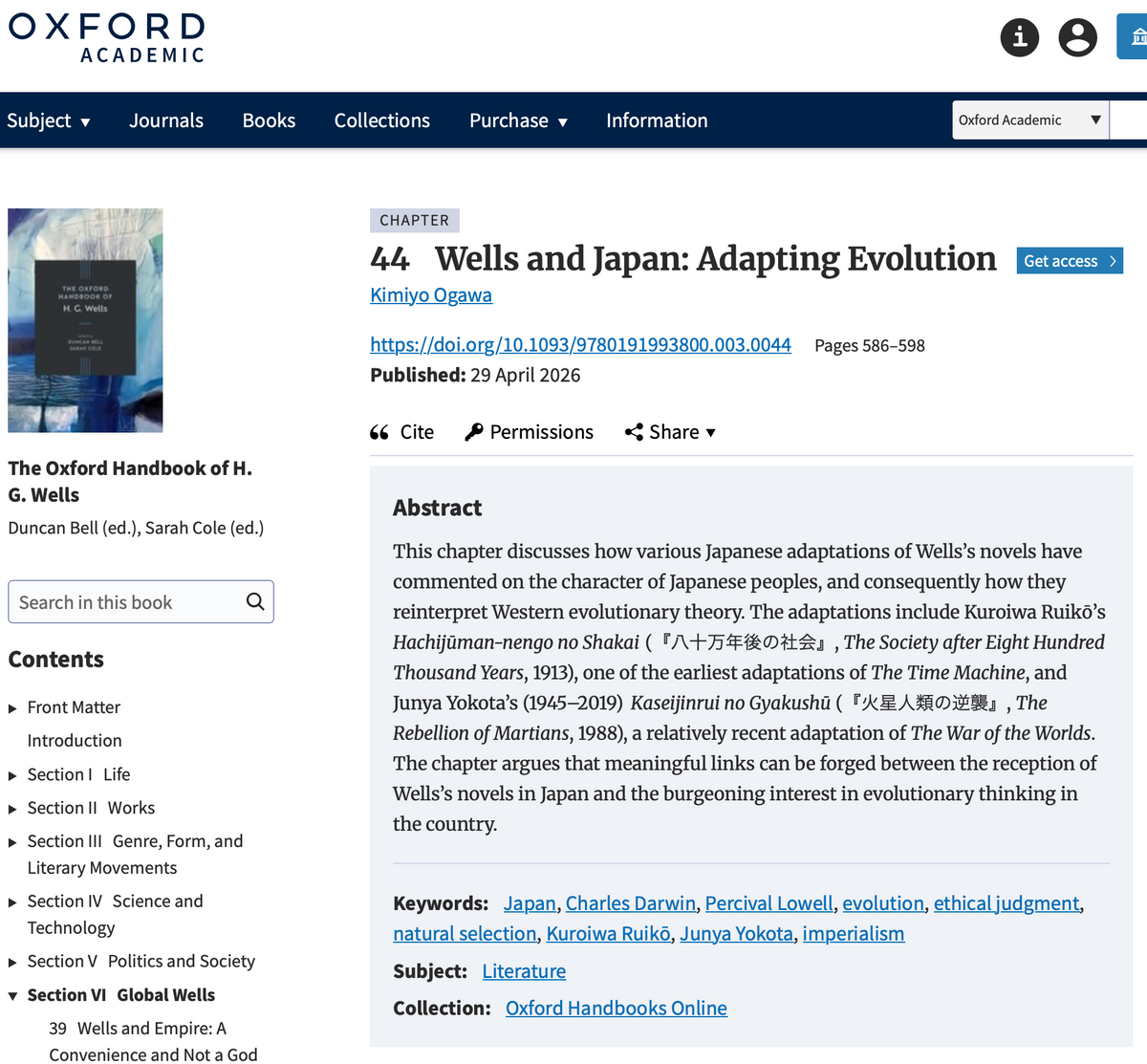
1. Historical significance. The Oxford Handbook of H. G. Wells (Oxford University Press, 2026) identifies Kuroiwa's Hachijūman-nengo no Shakai as "one of the earliest adaptations of The Time Machine" — the first known Japanese introduction of Wells's novel. A 2025 article in Japan Review independently confirms the 1913 Kuroiwa adaptation as the Japanese translation of record. CiNii and the National Diet Library corroborate the September 1913 publication date. Fusōdō's own 2020 reprint edition describes this work as the version that first introduced the novel to Japan.
2. The binding as artifact. The slipcase bears the HFB monogram of Shueisha — the printer's registered trademark — set against a grey-green ground dense with serrated leaves in the Art Nouveau manner. At the center, a large abstracted seed-pod rises into a curving flame: bold, strange, and unmistakably Taishō. The crocodile-grain cloth of the inner binding and the warm patina of the boards are exactly what 113 years of careful survival looks like.
3. Distinguished provenance. This copy was acquired on October 20, 1966 (Shōwa 41) by Itō Hideo — the foremost Japanese scholar of Kuroiwa Ruikō and Meiji-era detective and adventure fiction. The original bookseller's delivery slip, dated Shōwa 41, remains tucked inside. That a leading authority on Kuroiwa's work sought out this specific volume speaks to its significance. The book passed through the hands of the man who understood it best.
[CONDITION]
Good Vintage Condition — Exceptional Survival for 113 Years
- Slipcase: Intact overall. The Art Nouveau seed-pod and leaf design remains vivid. HFB monogram stamp clearly present. The bottom corners show significant wear with exposed board; the top corners show light wear consistent with age.
- Covers & Spine: Crocodile-grain cloth binding shows honest patina; structure sound. Title lettered in silver on the spine.
- Binding: Tight, secure, and fully intact.
- Interior & Pages: Age-toning (foxing) is present on the title page and preliminary leaves; interior text pages are notably cleaner. No tears, no inscriptions beyond the bookseller's provenance slip.
- Please carefully inspect all high-resolution listing photos to verify the vintage condition of this item.